US "Sanctions for Using Huawei Chips"... Even if Tariff War Stops, Chinese Semiconductors Are Targeted
Summary
- The Donald Trump administration warns that Huawei's Ascend chips may violate US export control laws.
- The US announced measures to strengthen export controls to block China's semiconductor rise.
- The Trump administration is expanding exports of US AI chips to the Middle East.
"Using Huawei Ascend Chips Violates US Export Controls"
Huawei's Latest Semiconductor 'Ascend'
80% Performance of NVIDIA H100
"As China's Semiconductor Presence Grows
US Takes Measures to Prevent Global Spread"
Trump Expands Supply to the Middle East
Exports 18,000 AI Chips to Saudi Arabia
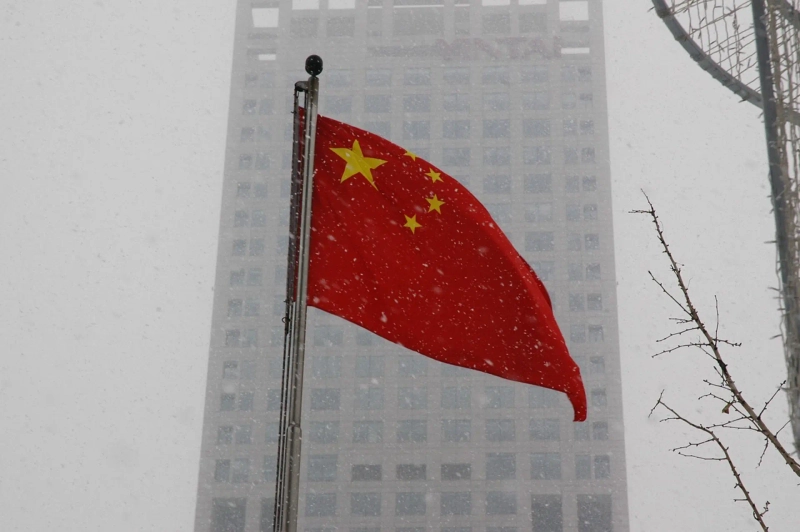
The Donald Trump administration in the United States has stated that "using Huawei Ascend chips anywhere in the world violates US export controls." The logic is that even if it's a Chinese-made semiconductor, if it contains US technology, it is subject to US export regulations, a measure to prevent Chinese AI chips from expanding their presence in the global market. Although the US agreed to a 90-day tariff war truce with China, it made clear its intention not to overlook China's 'semiconductor rise.'
◇ Targeting Huawei... Strengthening Export Controls
The US Department of Commerce's Bureau of Industry and Security (BIS) announced on the 13th (local time) that it would abolish the AI export control policy based on country ratings introduced by the previous Joe Biden administration, while taking measures to strengthen semiconductor export controls, including restrictions on the use of Huawei chips. BIS emphasized that using Huawei Ascend chips violates US export controls. The logic is that if high-performance Chinese chips, including the Ascend chip, are designed and produced using US software, design tools (EDA), and US semiconductor equipment, it violates US export control laws.
BIS provided the industry with a notice containing this information, specifying Huawei Ascend 910B, 910C, and 910D series as chips with a high possibility of violating export control regulations. Recently, these have been widely used in China for AI training and inference and have been noted as alternatives to NVIDIA products.
US tech media WCCFTech evaluated, "This may be the first time Huawei's AI chips have been mentioned in official documents," and "This shows that the Ascend AI lineup has made significant progress." It further pointed out, "The Trump administration does not want Chinese chips to spread outside of China and intends to limit their influence."
Additionally, BIS plans to warn companies and consumers about the consequences when US AI chips are used for AI model training and inference in China. The plan is to block China's strategy of indirectly securing advanced US AI chips through third countries.
◇ 'Caution Against China's Semiconductor Independence'
The US Department of Commerce's announcement is interpreted as a measure to block China's semiconductor rise centered on Huawei. Huawei is developing its own AI semiconductors to replace NVIDIA's high-performance AI semiconductors. It is showing moves to solve all processes, including semiconductor design, production, and packaging, in China. Recently, satellite images of a semiconductor factory Huawei is building in Shenzhen were reported by the Financial Times (FT).
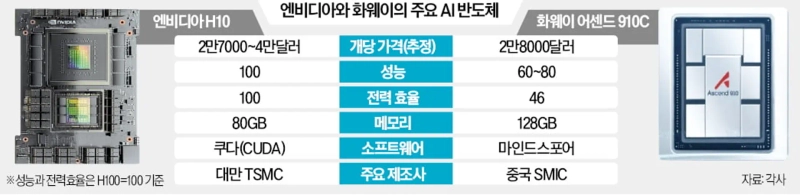
According to tech industry and company data, the performance of Huawei's latest semiconductor 'Ascend 910C' has reached 60-80% of NVIDIA's flagship product 'H100.' The price is 70-80% cheaper than the H100. DeepSeek, a Chinese AI startup gaining attention in the global AI market, used low-spec NVIDIA semiconductors in the AI development process but used Huawei products in the AI service process.
There were also foreign media reports that Huawei contacted Chinese technology companies last month to test the technical feasibility of the latest AI chip 'Ascend 910D' in the early stages of development. It is known that the first sample products are expected to be received as early as the end of this month. Huawei expects this chip to have stronger performance than NVIDIA's main product, the H100.
However, the impact of this measure on the semiconductor industry is expected to be limited. According to the Nihon Keizai Shimbun, Jonah Cheng, CIO of J&J Investment, analyzed, "The Ascend chip is in short supply to the extent that it cannot even meet Huawei's own demand, so its impact on overseas chip supply is not significant," and "Rather, US export restrictions aimed at excluding China from the supply chain have a much greater impact on China's semiconductor industry."
◇ Trump Increases Chip Exports to Middle Eastern Allies
BIS's announcement coincided with President Trump's Middle East tour. Jensen Huang, CEO of NVIDIA, accompanied President Trump's visit to Saudi Arabia, and NVIDIA decided to supply 18,000 of its latest AI chips, the GB300 Blackwell, to Humane, a company owned by the Saudi sovereign wealth fund. It plans to supply hundreds of thousands of advanced chips over the next few years. These chips will be used in data centers being built by Saudi Arabia to foster AI.
Bloomberg reported that the Trump administration is pushing a deal to allow the United Arab Emirates (UAE) to import more than 1 million of NVIDIA's advanced semiconductors. This is about four times more than what was allowed under the AI semiconductor export controls of the previous Joe Biden administration. The Trump administration is blocking Chinese AI chips while increasing exports of US AI chips. This aligns with what CEO Huang and other US big tech CEOs have recently said, that the US must supply more AI chips to the global market to win the AI competition with China.
Han Kyung-jae/Kim Joo-wan Reporter hankyung@hankyung.com

Korea Economic Daily
hankyung@bloomingbit.ioThe Korea Economic Daily Global is a digital media where latest news on Korean companies, industries, and financial markets.
![[Market] Bitcoin steadies after 'wash shock'…reclaims the $79,000 level](https://media.bloomingbit.io/PROD/news/2d67445a-aa24-46b9-a72d-5d98b73b6aec.webp?w=250)
![[Today’s Key Economic & Crypto Calendar] Atlanta Fed GDPNow, More](https://media.bloomingbit.io/static/news/brief_en.webp?w=250)
![[New York Stock Market Briefing] Rebound on bargain hunting in blue chips…Apple jumps 4%](https://media.bloomingbit.io/PROD/news/3710ded9-1248-489c-ae01-8ba047cfb9a2.webp?w=250)